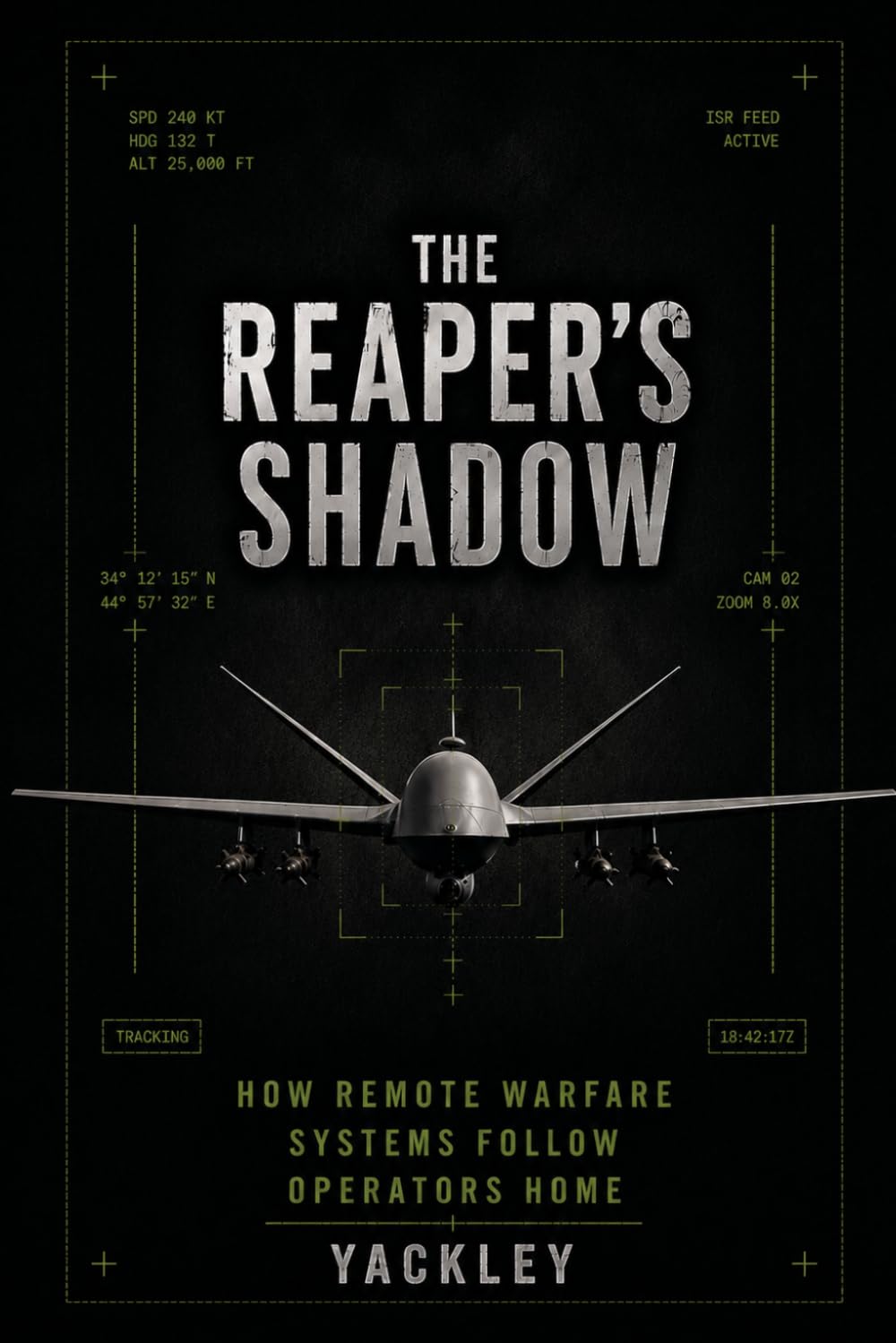
From Remote Warrior's founder
One perspective among many. This book is presented separately from the independent reading list so visitors can distinguish founder-authored work from outside references.
FOUNDER-AUTHORED BOOK · FIRSTHAND PERSPECTIVE
The Reaper's Shadow
How Remote Warfare Systems Follow Operators Home
By Tanner Yackley
An account of the people and working systems behind remote operations: long-duration attention, rapid work-to-home transitions, compartmentalization, responsibility, and how occupational adaptations may continue after service.
Read with context: This is a firsthand, practitioner-grounded perspective—not a clinical guideline or a universal account of remote warfare.
Browse the starting shelf
An annotated selection, not an endorsement of every claim. Covers are requested from Open Library; editions may vary, and unavailable images show a fallback.
Operational / practitioner synthesisOn Killing Remotely
Wayne Phelps
Explores the psychology and lived experiences of remotely engaged personnel. Interviews and interpretation do not establish a universal clinical profile.
Read with context: Practitioner synthesis, not a clinical guideline.
BEST FOR · Veterans, partners, providers RAF firsthand interviewsReaper Force
Peter Lee
Accounts from British Reaper personnel and their partners offer a valuable perspective outside the United States.
Read with context: Qualitative perspectives, not prevalence estimates.
BEST FOR · Families, operators, students Firsthand operational memoirHunter Killer
T. Mark McCurley with Kevin Maurer
A pilot's account of remote aircraft operations, mission work and the early armed-drone enterprise.
Read with context: One participant's perspective.
BEST FOR · Curious public, operators Reported historyPredator: The Secret Origins of the Drone Revolution
Richard Whittle
Traces the people, engineering and institutions that brought Predator from concept to operational reality.
Read with context: Historical journalism, not a contemporary operational manual.
BEST FOR · Readers new to UAS, educators Insider program historyNever Mind, We'll Do It Ourselves
Alec Bierbauer, Mark Cooter & Michael Marks
An inside account of early Predator operations and the organizational choices surrounding them.
Read with context: Pair with independent sources for balance.
BEST FOR · Military history and leadership Ethical analysisIs Remote Warfare Moral?
Joseph O. Chapa
A sustained argument examining moral responsibility and decision-making in remote warfare.
Read with context: Normative analysis, not ethical consensus.
BEST FOR · Readers asking about responsibility Academic perspectivesRethinking Remote Warfare
Edited by James Patton Rogers & James Wesley Hutto
A collection of scholarly contributions examining remote warfare, new technology and international security.
Read with context: Contributions have distinct methods and viewpoints.
BEST FOR · Researchers and educators Comparative combat memoirWhat It Is Like to Go to War
Karl Marlantes
Reflects on conventional combat and return to ordinary life; useful for comparison with, not substitution for, remote warfare.
Read with context: Not about the RPA experience specifically.
BEST FOR · Veterans, families, clinicians Influential / contestedOn Killing
Dave Grossman
A historically influential account of killing and training, including arguments that remain contested in the literature.
Read with context: Do not treat disputed claims as settled scientific evidence.
BEST FOR · Critical readers and researchers How we select books
We identify the author's role, source type, publication period and perspective; distinguish firsthand testimony from research; disclose material limitations; and include more than one viewpoint. Books do not replace clinical care, official guidance or independent evidence review.
Cover images: Open Library Covers API. Book cover rights remain with their respective rights holders. These small images accompany commentary and identification, not unrelated promotion.